
How would we travel and what it would be like in the future? If we all have a vision of the future we can make steps towards it, without being stuck with the problems we have today.
To help this visioning, I’ll cover some examples from places I’ve visited. I’ll relate this to my home county of Worcestershire UK, as it has an interesting mix of towns, Worcester city, villages and rural areas.
Imagine what it would be like to be in a liveable and sustainable place, where travelling is a much more enjoyable experience than it is today.
Let’s imagine taking a time machine to travel to a 2035 where everything that could have been done has been done to tackle inequality, health problems, nature loss, global heating and our divided society. We can base this imagined future on what has been achieved already in various parts of the world, so we can ground it in realism.
Currently choices for getting from one place to another are limited, and are getting worse. Busy roads make walking on pavements unpleasant, and cycling feels risky. Trains only serve certain locations and buses are infrequent and are usually the rejected ones from other parts of the country that have clean air zones, or comfort requirements such as air conditioning.
Cars are often the only option, which excludes young people from travelling independently and excludes those who cannot drive for health reasons. This extra traffic leads to health problems from stress, lack of exercise and air pollution. Cars occupy a huge amount of our public space, whether parked or moving. It’s a catch 22 situation that has been going on for years.
The government has a target of 50% of all journeys in towns and cities to be walked or cycled by 2030 but this can’t be reached with current traffic levels and road danger.
Here in 2035…
Now we’ll journey to a 2035 where everything that could have been done has been done.
Express cycle paths in 2035
We now have smooth and wide express cycle paths for travelling longer distances between towns and villages. It’s so great to cruise along these without having to stop every few metres, like in the old days. They’re designed for getting between towns and villages quickly with least effort. They’re wide enough for people to ride side by side and chat, or for faster riders to overtake easily. There are people with e-cargo bikes carrying goods to market and young children to school.
Sometimes the paths are beside roads but other times they take their own route though fields. When designing these routes it became standard practice to include women’s groups and disability forums in the design so the paths feel really safe. They have low level lighting so that they are safe at night, but don’t add to light pollution.
E-bikes are reliable thanks to good standards and now mean that hilly areas are no longer a problem for people of all abilities. In places where there are lots of people walking or horse riding, there are paths separate to the cycle path.
Is this possible?
Here’s an example of the cycle path between the outskirts of Eastbourne and Lewes, that takes people cycling off the busy A27 and goes on a super smooth path through fields and well behind the hedge that runs alongside the main road. Well done to National Highways for building this path.

Active Travel through towns and villages in 2035
In some areas I’ve visited, residents have voted to remove parked cars from their streets and use a car park a short walk away. Neighbours now chat to each other, and children play happily in the quiet road. There are fewer cars owned and car share schemes are commonplace.
Is this possible?
Here’s a car free district in Germany. The area of Vauban in Freiburg was designed as a sustainable district in 1996 and when you walk around now you hear people chatting, children playing and birds singing.


Cycle priority in 2035
Many smaller roads within towns and villages now have cycle priority, meaning that cars don’t overtake cycles. This has stopped rat-runs and cars stick to main roads to go places quickly. Lots of children cycle to school, with primary schools running bike buses. There’s less traffic in general so car journeys are now faster on average.
Is this possible?
Here in Utrecht, Netherlands, cycle priority streets are commonplace. They are also widespread in Ghent, Belgium.
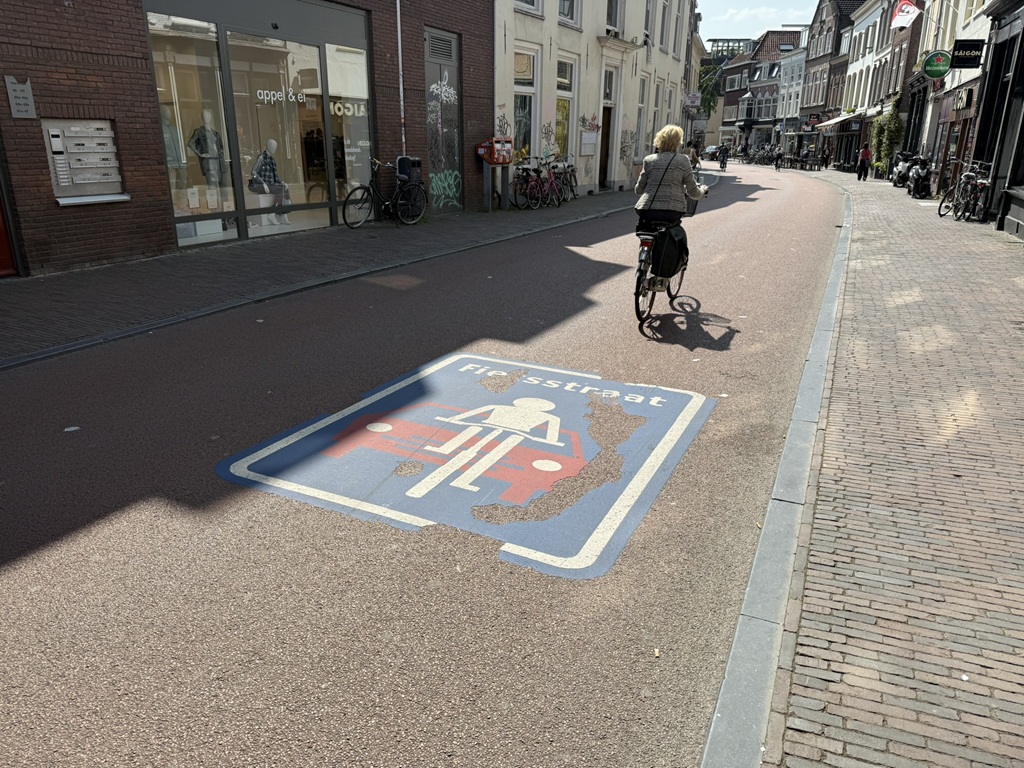
Centres of Towns and Cities in 2035
Centres are much more people friendly than before, and are alive with street cafes and markets. Now that there are cycle paths which are easily distinguishable from pavements, people traveling in different ways are separated so everyone feels safer.
Is this possible?
Here are some examples from Utrecht in the Netherlands, with cycle paths clearly separate to pedestrian areas. Note that the 30 symbol is 30km/h as it is a shared road for cycling and cars.


Here is the cycle parking rush-hour at the central train station in Utrecht.
Travel Options in 2035
People now have more choice on how to travel. Trains are reliable and cheap. For longer distances trains across Europe are really quick. Trams are now seen again in many more towns thanks to the Electric buses are clean and smooth and there are on demand buses to take people anywhere locally.
Trains now have bike carriages. A great example is that families often ride to a train station in Worcester and go for cycle rides in Herefordshire (getting off in Ledbury) or the Cotswolds.
Is this possible?
Lightweight trams are being trialled in Coventry, which don’t need deep foundations like traditional trams.

(Ref: https://www.coventry.gov.uk/coventry-light-rail)
Some trains in Wales started to have bike carriages in 2025, which are commonplace in many parts of Europe.
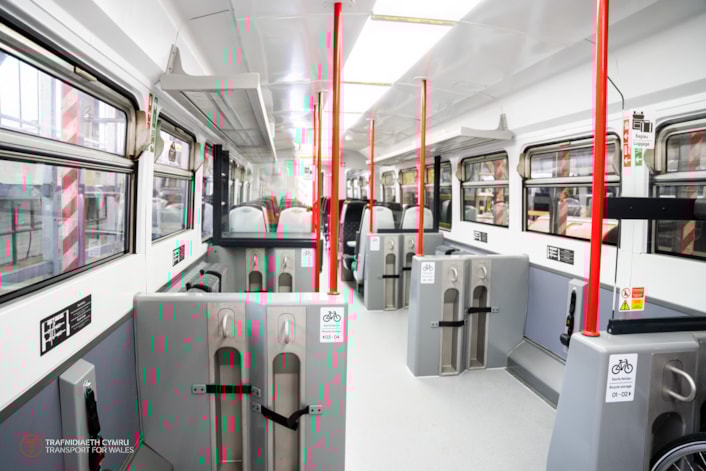
(Ref: https://news.tfw.wales/news/first-cycle-train-enters-service-on-the-heart-of-wales-line)
Finally
What can we do collectively to make this happen? Maybe we just talk about the ideas of a better future, to bring them closer to reality.